

Back pain and back injuries spike in winter due to icy surfaces, heavy activities during the winter and sudden slips. Cold temperatures also increase muscle stiffness and reduce circulation, which can make strains become more painful.
This article explains:
- The winter-back pain relationship
- Common injury types
- What to do immediately after an incident
- How physiotherapy supports recovery and prevents future problems
Why is back pain common during the winter
Back pain is more noticeable in cold months because muscles and soft tissues stiffen, circulation can reduce, and people change how they move. Colder temperatures make spinal muscles less elastic and slower to respond.
Therefore, everyday movements like getting up, bending, or lifting, place higher strain on tissues.
Behavioural factors amplify risk:
- People tend to be less active
- Sit for longer hours with stiffer posture
- Perform seasonal tasks (e.g., shovelling) that cause high-exertion of energy
Some patients perceive weather-related symptom changes (barometric sensitivity), though this is still considered an observation rather than proven fact.
Simple preventive steps such as light warm-ups, early assessment after a painful episode, and properly paced activity, reduce the chances of a minor ache turning into a functional problem.
Why back injuries increase during the winter
Back injuries increase in winter because the environment and related activities combine to raise the risk.
Icy surfaces lead to awkward slips and forced twisting motions overload the spinal structures. Heavy lifting and repetitive bending while shovelling snow also apply large force to the lumbar spine. Due to reduced daylight which causes hurried behaviour (trying to clear snow quickly) often means poor attention to technique and safety.
Older adults are especially vulnerable due to:
- Lower bone density
- Reduced muscle mass
- Changes in body balance
This makes fractures and more severe soft-tissue injuries more likely to happen after a fall.
Together, these factors make both acute trauma (e.g., sprains, fractures) and flare-ups of pre-existing back pain more common in the winter season.
Common back injuries after slips and falls in the winter
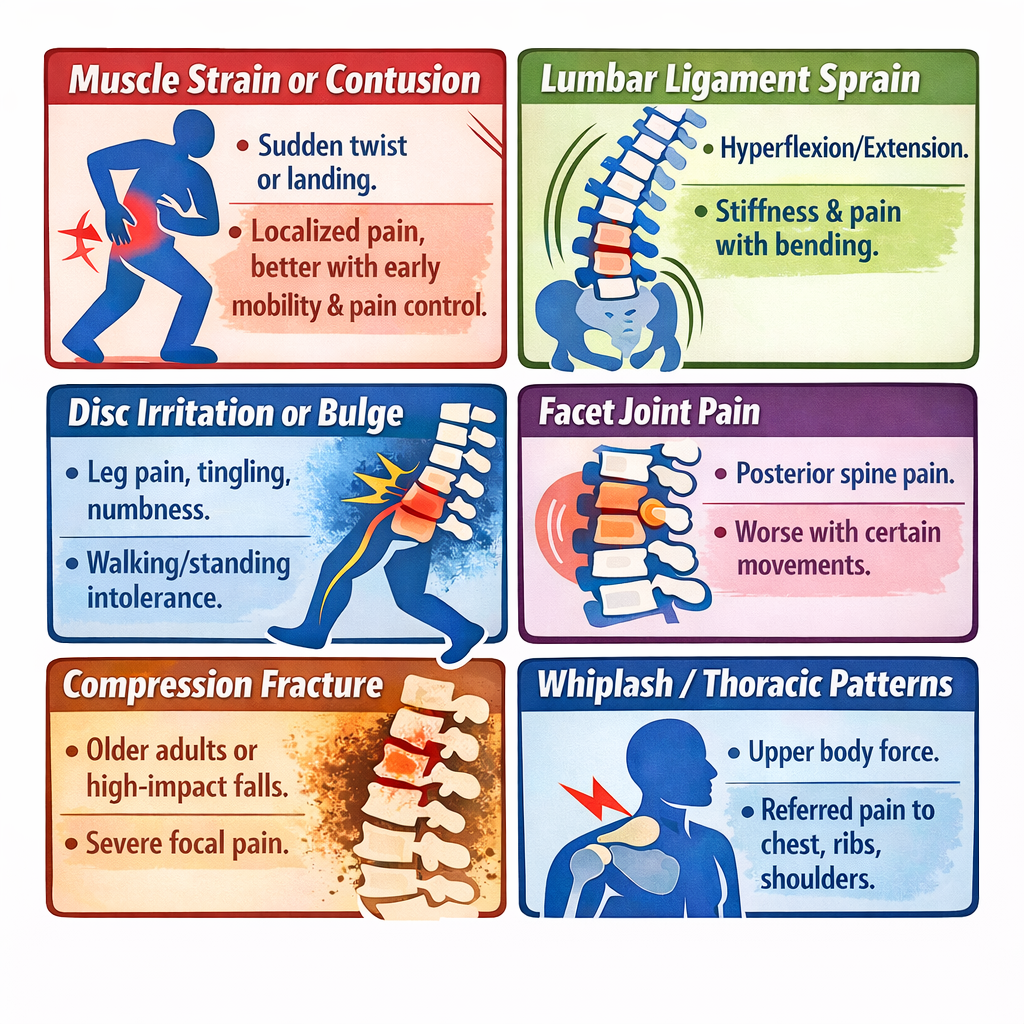
Back injury types commonly seen after winter slips and falls include a spectrum from mild strains to urgent cases. Below is a summarized table followed by brief descriptions and clinical cues to watch for.
| Injury Type | Typical signs | Urgency |
|---|---|---|
| Muscle strain or soft-tissue contusion | Local pain, tenderness, spasm; pain with movement | Low to moderate |
| Lumbar ligament sprain | Pain with certain movements, stiffness, guarded motion | Moderate |
| Lumbar disc irritation or bulge (mechanical sciatica) | Low back pain + radiating leg pain, numbness/tingling | Moderate to high (triage needed) |
| Facet joint irritation | Local posterior pain worse with rotation/extension | Low to moderate |
| Vertebral compression fracture | Sudden severe pain, limited mobility, height loss in older adults | High to urgent (triage needed) |
| Whiplash or thoracic injuries | Neck/back stiffness, referred pain patterns after upper-body impact | Moderate |
Causes and effects of back injuries
- Muscle strain or soft-tissue contusion: Often from a sudden twist or landing. Pain is localized, aggravated by active movement, and generally improves with early controlled mobility and simple pain control.
- Ligament (lumbar) sprain: Results from hyperflexion/hyperextension during a fall. Expect stiffness, difficulty with bending, and pain that increases with load intensive activities.
- Disc irritation or bulge (mechanical sciatica): Accompanied with radiating leg pain, tingling, or numbness. May cause walking or standing intolerance and requires clinical triage.
- Facet joint pain: Localized posterior spine pain, often worse with specific movements (e.g., standing upright from flexion). Responds well to manual therapy and graded movement.
- Compression fractures: Primarily in older adults or patients of high-impact falls. Severe focal pain and inability to move comfortably.
- Whiplash/Thoracic patterns: When the fall transmits force through the upper body; stiffness and referred pain to chest, ribs, or shoulder can occur.
If you suspect anything beyond a mild muscle strain such as numbness, progressive weakness, bowel/bladder changes, or severe localized pain, book a professional for assessment.
Scenarios leading to back injuries in the winter
Back injuries during winter are often predictable because of task and environment combinations:
- Shovelling snow: repetitive bending + heavy loads + poor technique → cumulative overload of lumbar muscles and discs.
- Icy walkways: an unexpected slip with rotational force can strain muscles, sprain ligaments, or provoke a disc flare.
- Climbing in/out of vehicles: awkward twisting while carrying items increases shear forces on the lower back.
- Falling off ladders/roofs while clearing snow: high-impact falls risk compression fractures and multi-region trauma.
- Car collisions on slick roads: rapid deceleration causes neck and thoracic loading that can refer pain to the lumbar region.
Each scenario combines mechanical load (force, repetition, awkward posture) with environmental risk (ice, snow, uneven surfaces) to produce the injury patterns described earlier, especially when people are fatigued or working quickly.
When to book an assessment
Back injury assessment is recommended when simple first-aid doesn’t resolve symptoms or when any urgent issues appear. Book a physiotherapy assessment if you have:
- Persistent pain lasting beyond a few days despite rest and simple first-aid measures
- Progressive or radiating symptoms (numbness, tingling, leg pain, weakness)
- Reduced mobility that prevents or limits everyday tasks such as walking
- Balance concerns that make you worried about repeat falls
- Need for a structured recovery plan after an injury or surgery
For an organized starting point and clinic details, see our General Physiotherapy page. Early triage helps avoid chronicity and speeds a safe recovery.
What physiotherapy is and how it helps
Physiotherapy uses evidence-based assessment and progressive treatments to reduce pain, restore function, and prevent recurrence. Core components include:
- Comprehensive assessments: movement screening, neurological checks (reflexes, sensation, strength), and functional analysis to identify tissue sources and urgent cases.
- Pain management strategies: activity modification, ice/heat guidance, taping, and advice for early symptom control.
- Manual therapy: joint mobilisations, soft-tissue release, and targeted hands-on techniques to reduce stiffness and restore motion.
- Graded movement programs: pain-free mobility work to re-establish safe ranges and reduce fear.
- Progressive strengthening: core and trunk conditioning delivered in staged progressions to build spinal support without overload.
- Balance & fall-prevention training: proprioception, reactive stability and environmental strategies. This is particularly important for older adults.
- Individualised recovery plans: timelines and staged goals to return to work, sport, and daily tasks safely.
- Education & self-management: posture, activity pacing, safe lifting techniques, and home exercise programmes to prevent recurrence.
The clinician tracks improvement with objective measures, adjusts load and progression, and equips you with tools to manage symptoms independently.
For slip/fall injuries, physiotherapy bridges the gap between acute care and long-term function, reducing the chance of chronic pain and improving confidence to resume daily activities.
Common exercise categories that support recovery
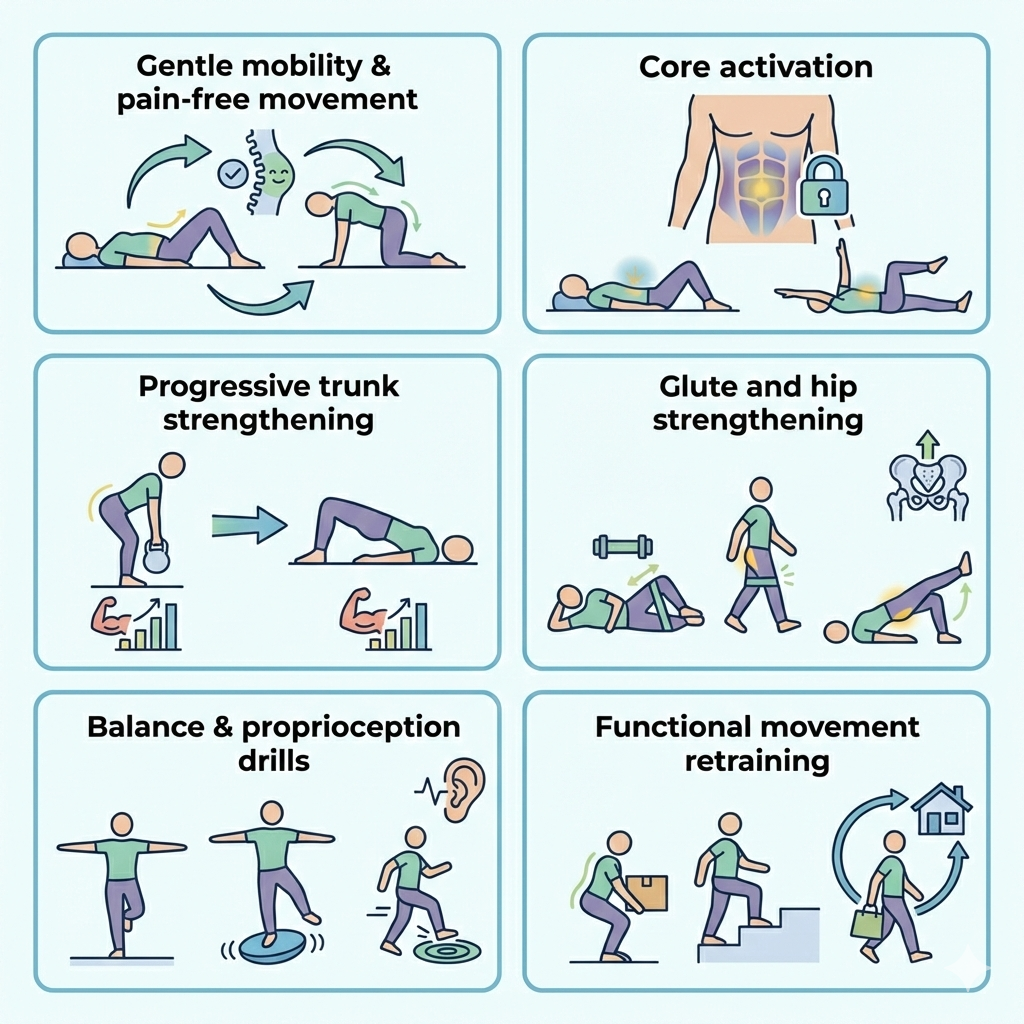
Back pain recovery exercises commonly used by physiotherapists begin gently and progress as pain and control improve. Below are exercise categories with descriptions:
- Gentle mobility & pain-free movement: tiny, controlled movements (pelvic tilts, cat-cow) to restore comfortable range without provoking pain.
- Core activation: low-load activation of transversus abdominis and multifidus (e.g., drawing-in, dead-bug progressions) to establish spinal support.
- Progressive trunk strengthening: once pain reduces, add loaded hip-hinge and bridging exercises to build endurance and functional strength.
- Glute and hip strengthening: clamshells, banded walks and single-leg bridges to offload the lumbar spine and improve pelvic control.
- Balance & proprioception drills: single-leg stands, wobble-board progressions and reactive stepping to reduce future fall risk.
- Functional movement retraining: safe lifting drills, stair negotiation, and gait training to restore day-to-day competence.
Practical tip: exercises should be guided with steady improvement. Sharp, progressive, or neurologic pain requires reassessment. Your physiotherapist will tailor sets, reps, and load progression to your stage of recovery.
How to avoid falls or slips in the winter season
Back injury prevention in winter focuses on environment, technique, and pacing:
- Warm up before heavy tasks: 5 to 10 minutes of light movement (marching, gentle lumbar mobility) to raise tissue temperature.
- Pace chores: take frequent short breaks while shovelling. Split heavy tasks into smaller, manageable tasks.
- Use ergonomic aids: choose lighter shovels with ergonomic handles, use push-shovels when possible, and consider snow blowers for large areas.
- Lift safely: lead with the legs, hinge at the hips (not the lower back), keep the load close to the body, and avoid twisting while lifting.
- Wear stable footwear: shoes with good traction, ice cleats for walking on compacted snow/ice, and remove wet footwear quickly to avoid slips when indoors.
- Create a safety plan for older adults: clear entrances, use handrails, maintain good lighting, and arrange help for heavy outdoor tasks.
- Manage indoor posture: avoid prolonged slumped sitting. Set timers to move and perform short mobility breaks.
Combining behavioural changes with simple tools and sensible planning reduces both immediate and cumulative back pain.
FAQs
Q: How long until I can shovel again or do heavy work?
Back pain or back injury timelines vary. Mild strains may allow light, modified shovelling within days with guided progression. More significant strains, disc irritations, or fractures need staged rehabilitation.
Q: Can physiotherapy help with pain and balance after a fall?
Back pain and balance issues commonly improve with physiotherapy. Treatment targets pain control, strength, proprioception and task-specific training to restore confidence and reduce recurrence.
Next steps

Back injury support: if winter activity has left you stiff, sore, or in pain, our team can help. Learn more about our General Physiotherapy services or book an assessment to start a tailored recovery plan today.