
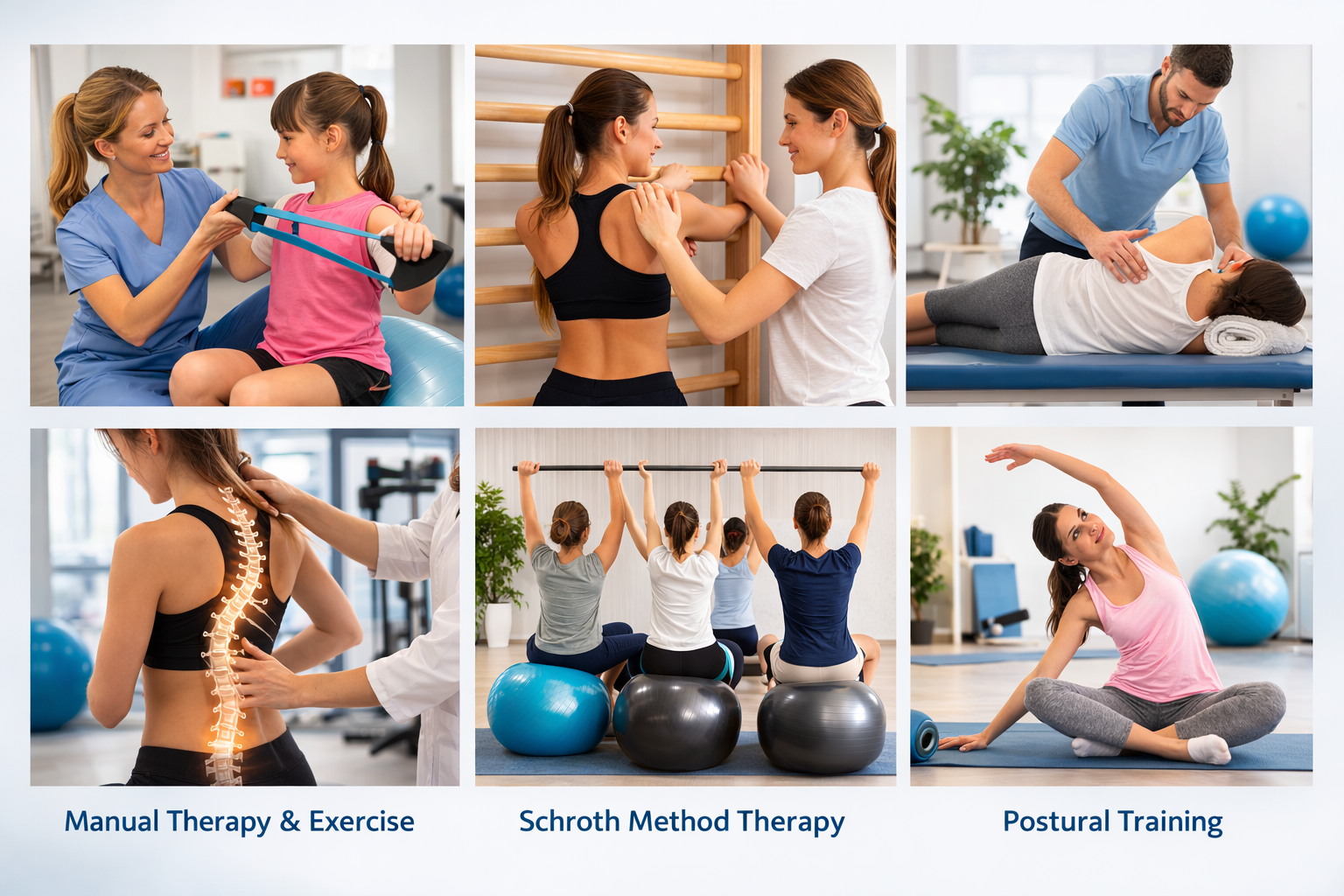
Scoliosis often can be managed without surgery. Many curves are mild or moderate and respond well to conservative care.
This article covers:
- Types of scoliosis you might see
- How physiotherapy helps
- When a schroth program or small group treatment is commonly used in clinic programs
Types of scoliosis and why it matters for treatment
Scoliosis comes in several main types and the type matters because it changes the likely course, what to monitor, and which physiotherapy strategies will help most.
- Idiopathic (most common): unknown cause, usually appears during adolescence. The typical pattern is the right thoracic curve in many teens.
- Congenital: spinal bones form abnormally before birth. Curves can be present in infancy and often need close medical monitoring.
- Neuromuscular: associated with conditions like cerebral palsy or muscular dystrophy. Curves may progress differently and physiotherapists may work alongside medical and surgical teams in these situations.
- Idiopathic (most common): unknown cause, usually appears during adolescence. The typical pattern is the right thoracic curve in many teens.
The key measurement physiotherapists use is the Cobb angle which is a single-number measure on X-ray that quantifies curve size and helps guide treatment choices.
Why age and curve pattern matter
- Age or growth potential influences risk of progression (younger, growing spines are more likely to change).
- Curve location & direction (thoracic vs lumbar, single vs double) determine which muscles, breathing patterns, and daily-life habits need targeted work.
- Age or growth potential influences risk of progression (younger, growing spines are more likely to change).
This is why physiotherapy programs are tailored to the patient’s curve type, growth stage and functional goals.
What can physiotherapy do for you
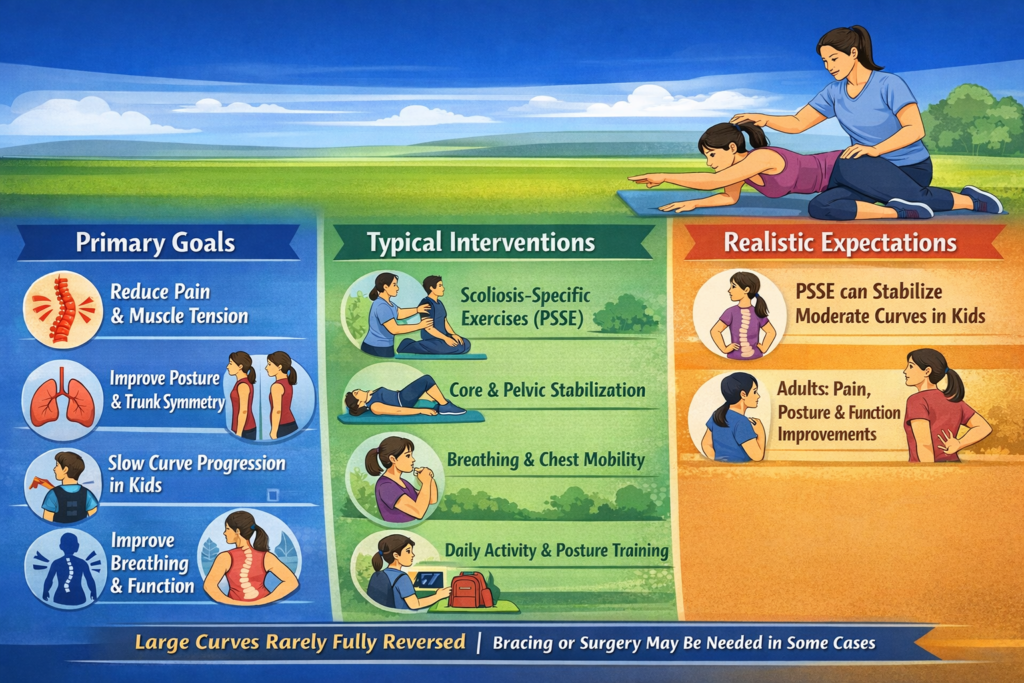
Scoliosis-focused physiotherapy aims at practical, measurable goals but it also sets realistic expectations.
Primary goals
- Reduce pain and muscle tension.
- Improve posture and trunk symmetry (appearance and comfort).
- Slow or reduce curve progression in growing children when combined with monitoring/bracing.
- Improve function and breathing capacity (especially with thoracic curves).
Typical interventions
- Individualized Physiotherapeutic Scoliosis-Specific Exercises (PSSE) programs taught by trained physiotherapists.
- Core and pelvic stabilization exercises for lumbar curves.
- Breathing training (rotational/angular breathing) and chest mobility for thoracic curves.
- Functional training and daily habit retraining (sitting, school bag use, sport modifications).
Realistic Expectations
Physiotherapy can rarely fully reverse very large structural curves on its own.
For moderate curves in growing children, PSSE can help stabilize or reduce progression. For adults, improvements are usually in pain, posture and function rather than major curve reversal.
Evidence-based PSSE at our Canada Scoliosis & Neuro Centre
Scoliosis physiotherapy at the clinic follows evidence-based PSSE approaches (for example Schroth) that are supported by systematic reviews showing benefits for trunk symmetry and quality of life.
How approaches change by curve pattern
Below are short notes on how physiotherapy priorities shift depending on curve pattern.
| Curve pattern | Main physiotherapy aims |
|---|---|
| Thoracic curve (often right thoracic in adolescents) | De-rotate and elongate the thoracic spine; improve rib symmetry and breathing. |
| Lumbar or thoraco-lumbar curve | Stabilize the pelvis, strengthen lumbar support, reduce compensatory low-back pain. |
| Double or S-shaped curves | Achieve balance between curves; prioritize the structurally dominant curve while improving global alignment. |
| Infant / congenital / neuromuscular scoliosis | Early monitoring, maximize mobility and function; physiotherapy complements other medical measures. |
What is the Schroth Method
The Schroth method is an individualized, three-dimensional approach that combines postural correction, rotational angular breathing and sustained isometric holds to derotate, elongate and stabilize the spine.
- How it works: targeted asymmetric corrective positions + guided breathing to expand the concave chest wall and retrain muscle activation.
- Who benefits most: growing adolescents with idiopathic curves and motivated patients who will follow a home exercise program and attend regular supervised sessions. Schroth programs are also adapted for adults to reduce pain and improve posture/breathing.
- How it works: targeted asymmetric corrective positions + guided breathing to expand the concave chest wall and retrain muscle activation.
Evidence: Schroth is among the most studied PSSE approaches. Our reviews show improvements in trunk symmetry, quality of life and angle-of-trunk-rotation, with stronger evidence when combined with bracing for some patients.
Why group treatment helps kids
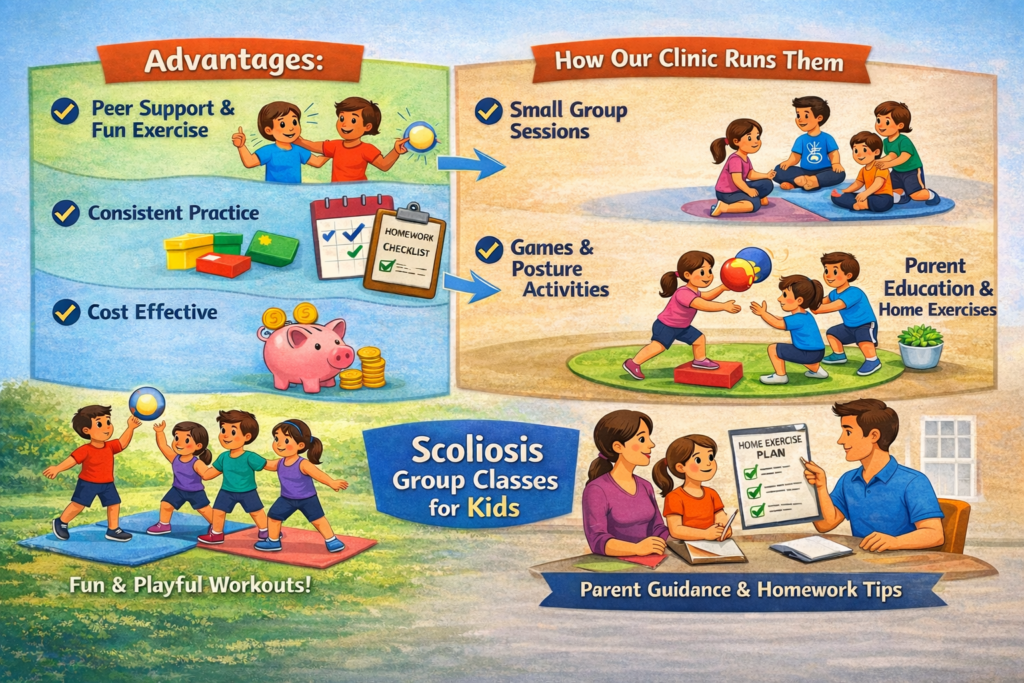
Scoliosis group classes can be an effective, developmentally appropriate option for many children.
Advantages
- Peer support and normalized activity: kids often enjoy exercises more when done with peers.
- Improved adherence: regular class schedule + homework checklists increase practice consistency.
- Cost-effective: lower per-family cost while still allowing curve-specific instruction
- Peer support and normalized activity: kids often enjoy exercises more when done with peers.
How our clinic runs them
- Small groups (curve-type grouping where possible).
- Playful, age-appropriate progressions (games that reinforce posture and breathing).
- Small groups (curve-type grouping where possible).
Parent education sessions and a clear home-exercise checklist so families can continue practice between sessions.
When to consider surgical referral
Surgical referral is typically discussed when curves progress to thresholds (commonly around or above 40° to 50° depending on age, symptoms and progression) or when function/respiration is affected.
Easy takeaways for families
- Posture checks: watch for uneven shoulders/hips or changed posture after growth spurts.
- Schedule an assessment: early evaluation gives more options and usually better outcomes.
- Start simple exercises: daily short exercises + breathing drills make a difference.
- Track growth and symptoms: note rapid height changes, pain, or activity limits. Bring these to your clinician.
- Posture checks: watch for uneven shoulders/hips or changed posture after growth spurts.
Next steps
Book a scoliosis assessment at Canada Scoliosis & Neuro Centre to get a curve-specific plan.
Our services include
FAQs
Can physiotherapy stop scoliosis for kids?
Yes, it can slow or stop progression in many growing children. It commonly reduces pain and improves posture in teens and adults.
Is Schroth suitable for adults?
Yes, Schroth-based principles help adult patients with posture, pain and breathing. Though large structural angle reversal is less likely than in growing spines.