
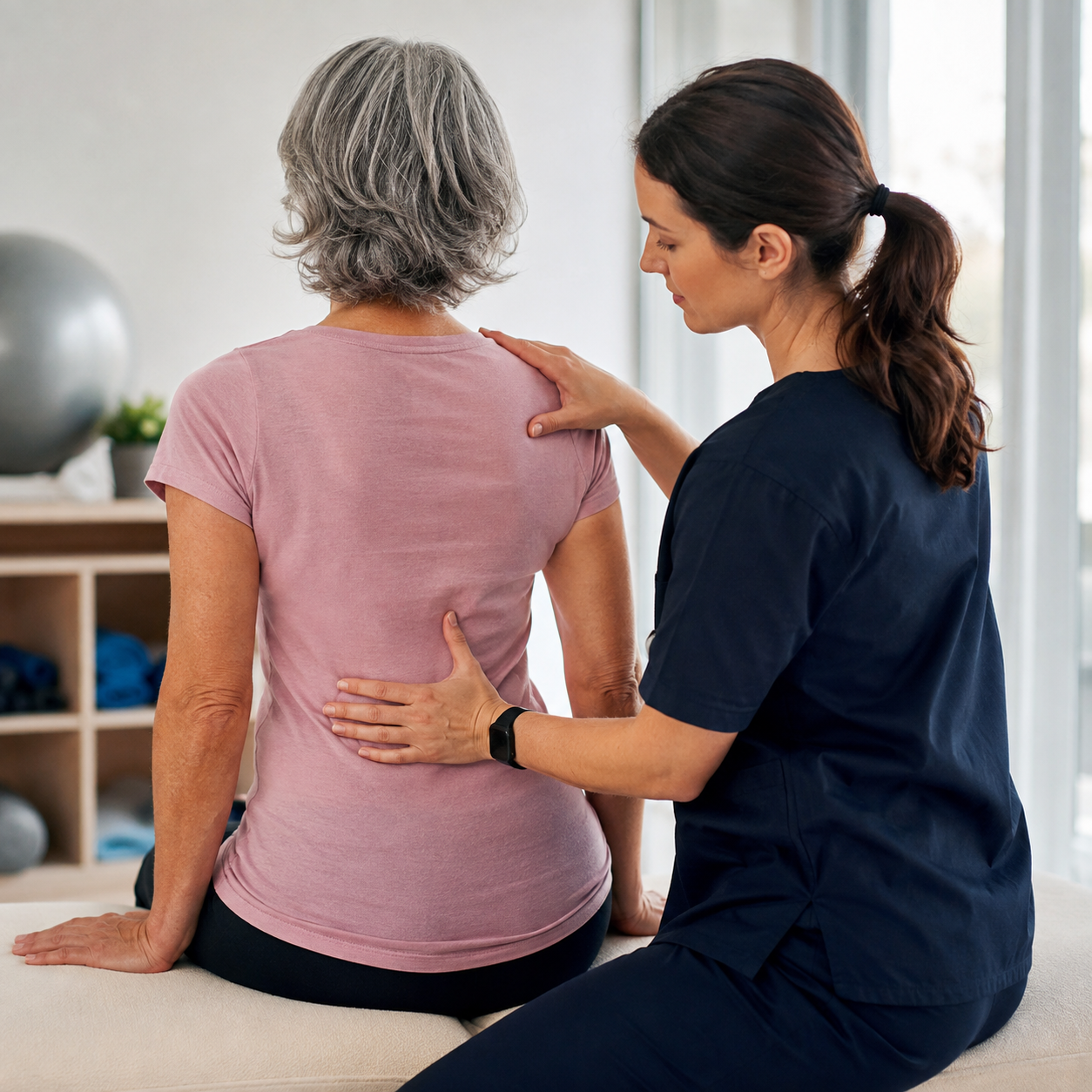
For many adults, scoliosis doesn’t look like the condition from a childhood screening poster. It shows up gradually; a persistent ache after a long day at a desk, a sense that one hip or shoulder sits higher than the other, or the quiet realization that clothes no longer hang quite the way they used to.
Some have carried a curve since adolescence that never fully resolved; others develop degenerative scoliosis later in life, as the spine’s discs and joints change with time.
Whatever the starting point, the questions tend to be similar: Is this going to get worse? Do I need surgery? What can I actually do about it?
For most adults, the answer isn’t a single procedure. It’s a structured, individualized rehabilitation plan that treats pain, movement, and daily function as a connected whole.
What Is Adult Scoliosis?
Scoliosis is a three-dimensional change in the shape and alignment of the spine. It may be a curve that developed earlier in life and continued into adulthood, or it may have developed later alongside degenerative changes in the spine. Some adults have few symptoms, while others experience pain, stiffness, changes in balance or difficulty maintaining an upright posture.
A radiograph can provide important information about the location and characteristics of a curve. However, an image does not explain everything a person experiences. Two adults with similar radiographic findings may have very different levels of pain and functional ability.
For this reason, adult scoliosis treatment is most useful when the assessment connects the structural findings with what the person is experiencing in real life.
Our Adult Scoliosis Program: Individualized, Functional and Education-Based
Our adult scoliosis program is an individualized, function-oriented and education-based rehabilitation program designed to help patients better understand their spinal condition, improve movement and postural control, manage symptoms, and develop sustainable self-management strategies.
The initial assessment is comprehensive and it integrates:
- Lifestyle, occupational and activity demands, and relevant behavioural factors, medical history and associated comorbidities.
- Thorough pain assessment, both from a mechanical and neuropathic perspective.
- Functional limitations and movement competency; we try to identify contributing mechanical factors, including stiffness, instability, axial loading, postural inefficiencies and movement-related overload/ factors that may contribute to symptom persistence or progression.
- Postural alignment, patient strategies for postural control/ load distribution/ etc.
- Review of radiographic findings, curve characteristics and classification.
- Identification of individual functional goals.
We encourage patients to participate in making an interactive plan of care that can respond to the patient’s stage of readiness and life commitments. The highlight of the program is its simplicity. It is easy to incorporate in daily activity routine, which increases compliance.
The Plan: Building Skills That Carry Into Everyday Life
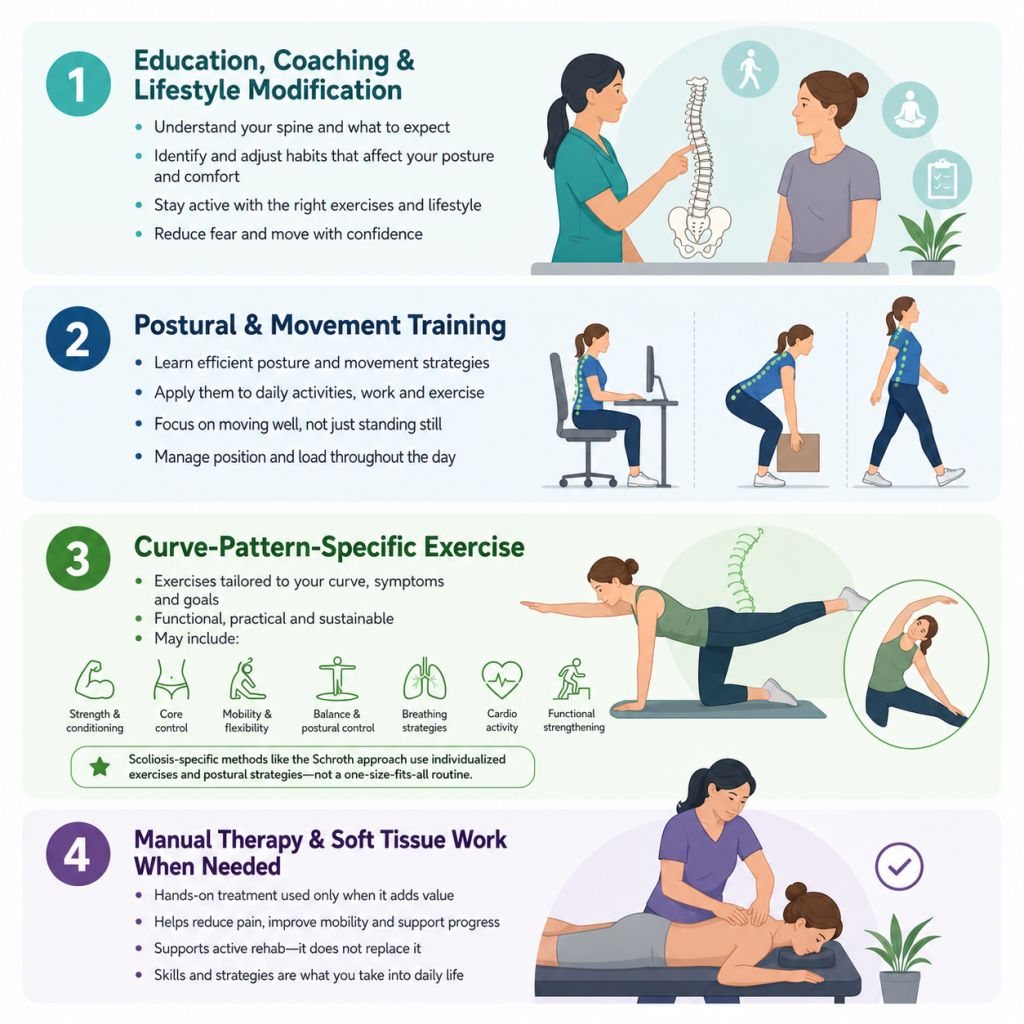
1. Education, Coaching and Lifestyle Modification
Patients are provided with education on their spinal condition.
They are coached in identifying and gradually modifying habitual movements and postural behaviours. We address lifestyle and activity-related factors. Patients are encouraged to focus on optimizing physical conditioning and fitness, including appropriate modifications to their existing exercise routines.
Education can also help reduce uncertainty around activity. Adults may worry that certain movements will damage their spine or make their curve worse. Instead of relying on fear-based restrictions, we help patients understand their own symptoms and learn how to approach activity appropriately.
2. Postural and Movement Training
We work with patients to learn and apply postural control strategies that are more efficient, with emphasis on translating these strategies into functional activities and everyday life rather than simply achieving a static “correct posture.”
The same goes for movements. We try to retrain and optimize movement strategies and make them relevant to their activities of daily living, including work, physical activity routines, and habitual tasks.
This means learning to manage position and load dynamically rather than trying to maintain one rigid posture throughout the day.
3. Curve-Pattern-Specific Exercise
Scoliosis-specific exercises are selected according to the individual’s curve pattern, clinical presentation and functional needs. In adults, our emphasis is on making these exercises functional, practical and sustainable, rather than treating the radiographic curve in isolation.
Depending on the individual, exercise may include:
- Strength and conditioning
- Trunk and core control
- Mobility and flexibility work
- Balance and postural control
- Breathing-related strategies where appropriate
- Adapted cardiovascular activity
- Functional strengthening related to work, recreation, or home activities
Scoliosis-specific approaches such as the Schroth Method use individualized exercises and postural strategies rather than a generic exercise routine.
4. Manual Therapy and Soft Tissue Work When Needed
Active treatment with manual therapy and soft tissue work is only provided when needed to optimize the results.
The emphasis remains on helping the patient participate in active rehabilitation and develop skills that can be carried into everyday life. Hands-on techniques are therefore used as part of the overall plan rather than as a replacement for exercise, education, and self-management.
What Makes a Good Adult Scoliosis Exercise Program?
A useful exercise program should be realistic enough to maintain. For an adult managing work, family responsibilities, exercise, and other commitments, a plan that requires a large amount of additional time may be difficult to sustain.
A practical program may involve:
| Instead of… | The focus can be on… |
|---|---|
| Avoiding movement out of fear | Understanding and gradually improving movement tolerance |
| A long list of unrelated exercises | A smaller number of purposeful exercises |
| Exercising only during appointments | Incorporating strategies into normal routines |
| Focusing only on posture | Developing adaptable postural and movement control |
| Treating the X-ray alone | Connecting the curve with symptoms and functional goals |
The goal is to help patients become more confident and capable in managing their condition.
When Should You Consider Adult Scoliosis Physiotherapy?
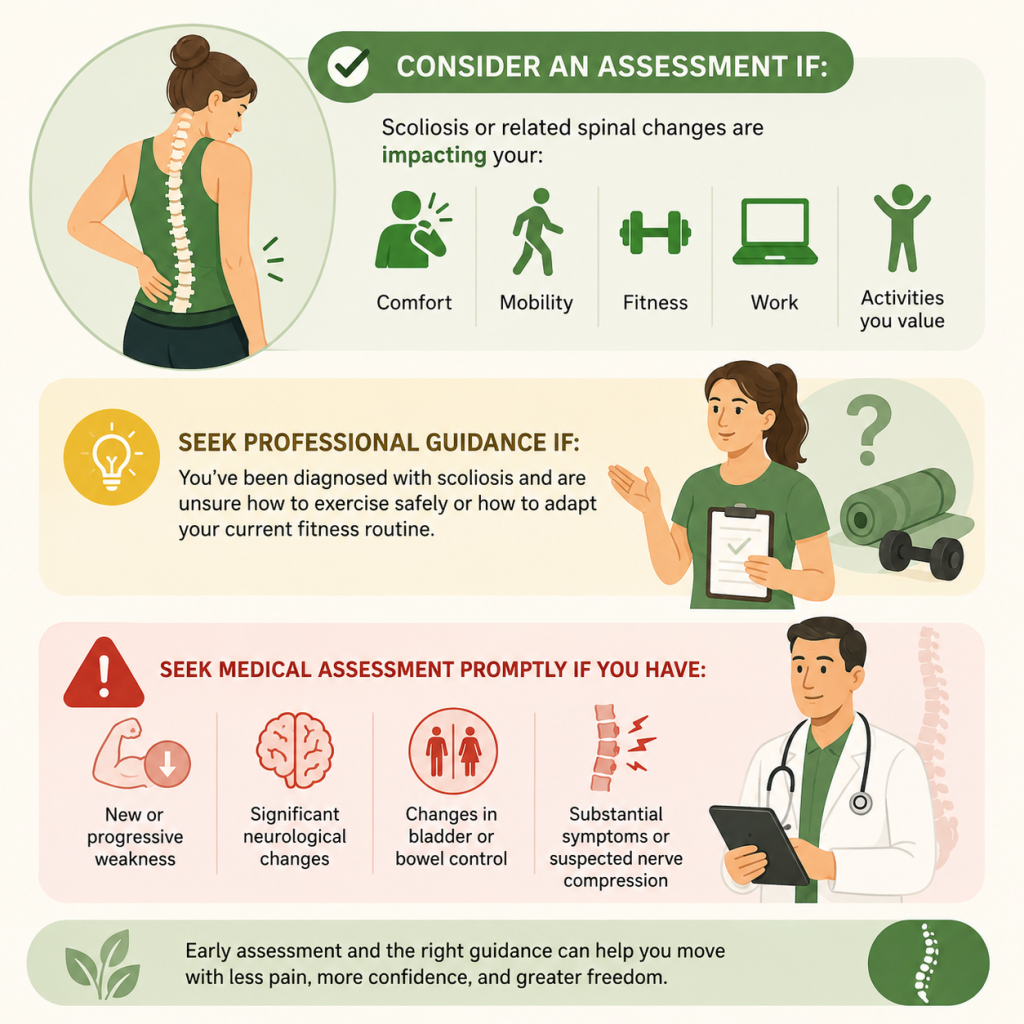
Consider an assessment when scoliosis or associated spinal changes are affecting your comfort, mobility, fitness, work, or participation in activities you value.
It is also reasonable to seek professional guidance when you have been diagnosed with scoliosis but are unsure how to exercise safely or how to adapt an existing fitness routine.
However, some symptoms require medical assessment rather than simply continuing with exercise. New or progressive weakness, significant neurological changes, or changes in bladder or bowel control should be assessed promptly. Adults with substantial symptoms or suspected nerve compression may also require further medical investigation.
What Can You Expect From Adult Scoliosis Physiotherapy?
Treatment should evolve as your needs change. Early sessions may focus on understanding your condition, identifying symptom triggers, improving movement options, and establishing manageable exercises. Over time, treatment can progress toward strength, endurance, physical activity, work demands, and long-term self-management.
Progress does not necessarily mean a dramatic change on an X-ray.
For one person, success may mean walking farther without discomfort. For another, it could mean returning to the gym, working more comfortably, improving confidence with lifting, or having a better understanding of how to respond when symptoms fluctuate.
That functional perspective is central to our approach.
Adult Scoliosis Physiotherapy in North York, Toronto
At Canada Scoliosis & Neuro Centre, we focus on creating treatment plans that fit the individual rather than applying a standard program to everyone. Our centre is located at 504–685 Sheppard Ave E in North York, Toronto, making it accessible to anyone looking for scoliosis physiotherapy in the North York area.
Our approach combines assessment, education, movement training, individualized exercise, and symptom management with an emphasis on practical application.
The objective is simple: help you understand your scoliosis, move with greater confidence, stay as active as appropriate, and develop strategies that can become part of daily life.
Book an appointment at our clinic to discuss your scoliosis and your rehabilitation goals.
Frequently Asked Questions
Can physiotherapy straighten adult scoliosis?
Physiotherapy should not be presented as a guaranteed way to straighten an established adult spinal curve. Its goals are generally focused on symptoms, movement, strength, function, physical activity, and self-management.
What exercises are best for adult scoliosis?
There is no single best exercise for every adult with scoliosis. Exercise selection should reflect the individual’s curve pattern, symptoms, movement findings, physical capacity, and goals. Scoliosis-specific exercise may be incorporated where appropriate.
Can I continue going to the gym with scoliosis?
Many adults can remain physically active, although the appropriate type and intensity of exercise may need to be adapted. A physiotherapist can help identify sensible modifications based on symptoms, movement, fitness, and goals.
Do I need an X-ray before physiotherapy?
An X-ray can provide useful information about the curve, but the physiotherapy assessment also considers symptoms, movement, function, medical history, and goals. We advise patients to bring relevant X-rays or medical reports when available.
Note: This article is for general educational purposes and isn’t a substitute for individualized medical assessment. If you’re experiencing back pain, postural changes, or other symptoms, please consult a qualified healthcare provider for guidance specific to your situation.